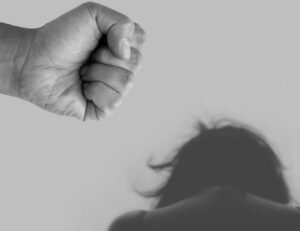
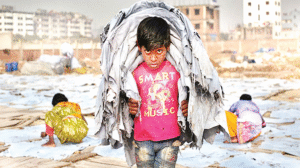
I want to talk about two people today – a child and a woman. Do you know why I am talking about this – maybe you do or maybe you don’t. I will talk about a child because he cannot speak for himself about his rights, about deprivation, about cruelty by others, etc. Therefore, as a strong voice of the society, as a conscientious person, you or I have to speak on his behalf. He has to return his rights, you – me and the society have
to stand against his injustice.
Now I will talk about a woman. She may be able to speak for herself, stand against injustice, go to the law to address injustice, and the law has given her that right. But what happens in reality, what happens in this land of my birth? Society or the country may be able to give a lot, plan for them, make promises, etc., but I can’t see anything. When they speak for themselves, society scolds them, society says that she is a shameless and impudent woman, society says that she is a shameless woman. Not only that – this society then takes on a terrifying form. Starting from physical abuse, family pressure, verbal abuse, social ostracism, and even acts like gang rape, do not hesitate. That is why my country, Bangladesh, is “A Land Of Dispariy“.And that is why you – I have to talk about this abused, oppressed, and neglected creature. Otherwise, every conscious citizen will have to come forward in a group manner.
Illegal and low-paid employment of children in risky work:
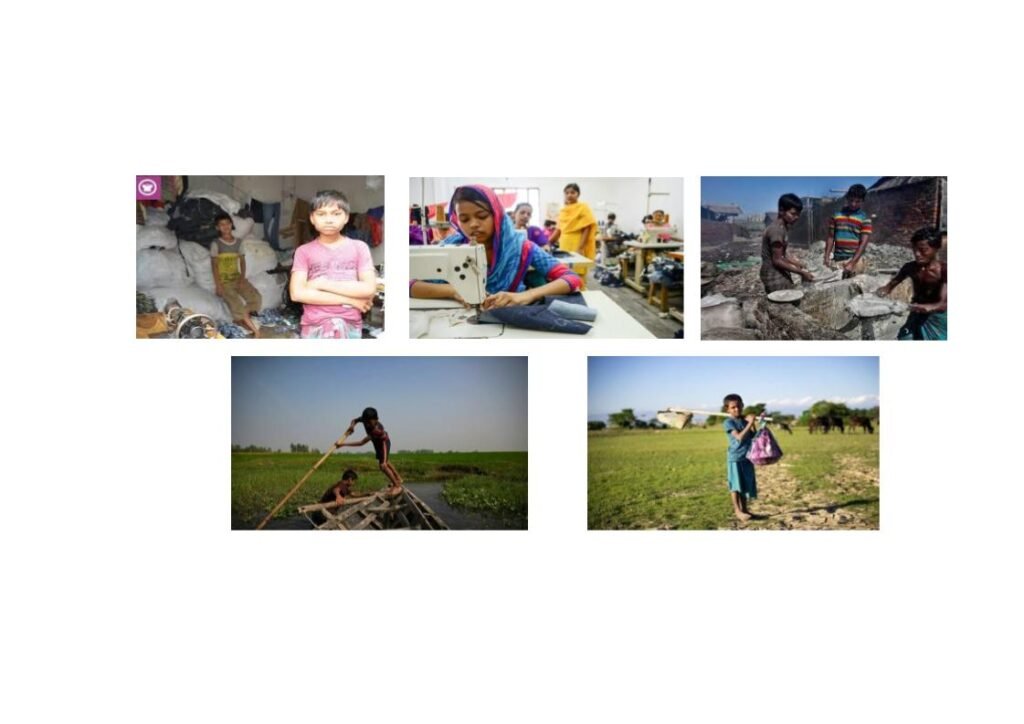
Do you see the above pictures clearly? Do you see pictures of your children, relatives, neighbors, or any of your loved ones? You can get it. I know you can’t. I want to give you a statistic showing that they are being made to do low-wage, illegal, and hazardous work. + Ready Made Garments (RMG) and Under Sub-Constructed Workshops: Although child labor is not seen in official or large garment factories, child labor is seen in small sub-factories
for low wages, which is not supported by the Bangladesh Labor Act 2006, and the ILO Minimum Age Convention (No. 138).
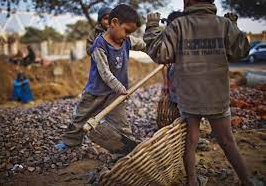
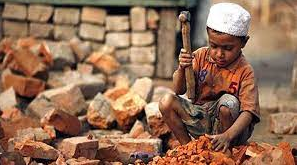
+ Brick kiln: When I go to the village or to my uncle’s house in the village, I am very surprised to see that at an age when they are supposed to go to school, to play with their friends – at that age they are breaking hard bricks into small pieces, cutting wood in the brick kiln, doing such risky work for a small salary in exchange for work. The work is against the ILO and the Bangladesh Labor Act.(the minimum age for employment at 14) (ILO survey report)
+ Leather workshop :Children are employed in leather workshops in Bangladesh.The leather industry cannot be operated without the use of chemicals.Working with such chemicals is extremely risky for children.

+ Shipbreaking (Chittagong / Sitakunda) :This is a very risky and unhealthy job.It should be strictly prohibited by law and the guilty should be brought to justice.
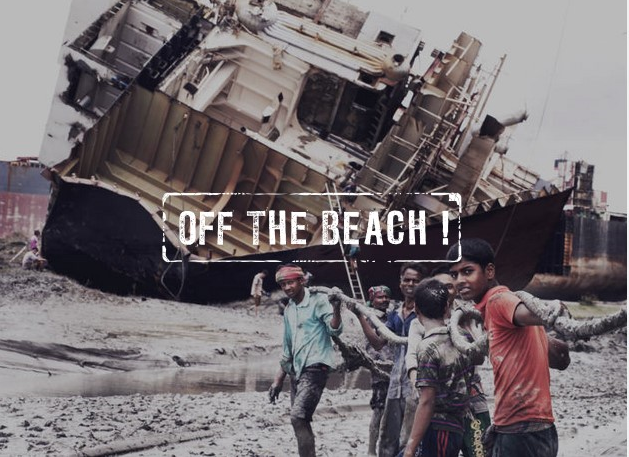
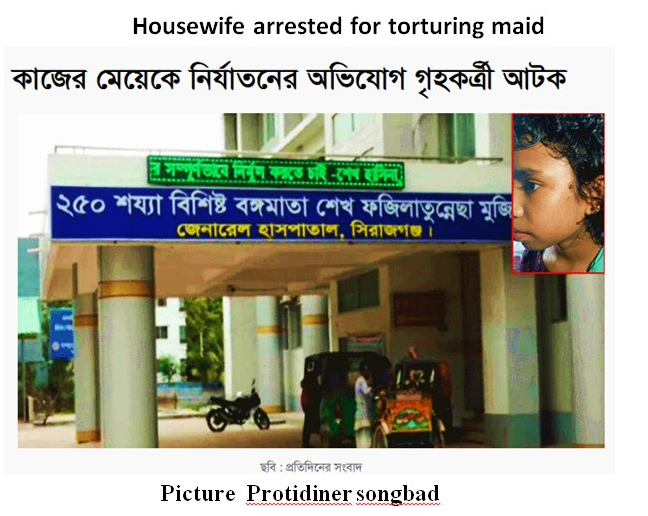
+Domestic work: According to a survey by theUNICEF and International Labor Organization, a large number of women in Bangladesh are engaged in low-paid domestic work and many are subjected to sexual harassment and rape, along with physical abuse.This can be eliminated through public awareness and strict enforcement of laws.
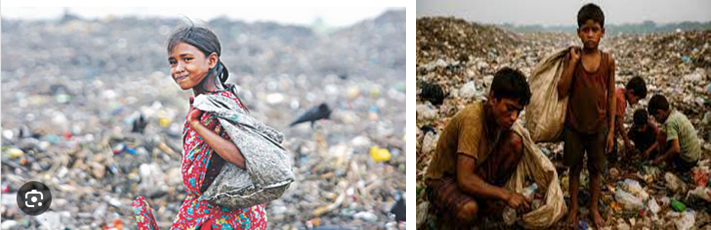
Street waste collection: In big cities or slums, small recyclable items such as plastic bottles, rotten fruits thrown away from homes, food waste, glass bottles, etc., lying in various dustbins are collected, causing their bodies to suffer from various serious physical diseases.
Overall Statistic
Children:
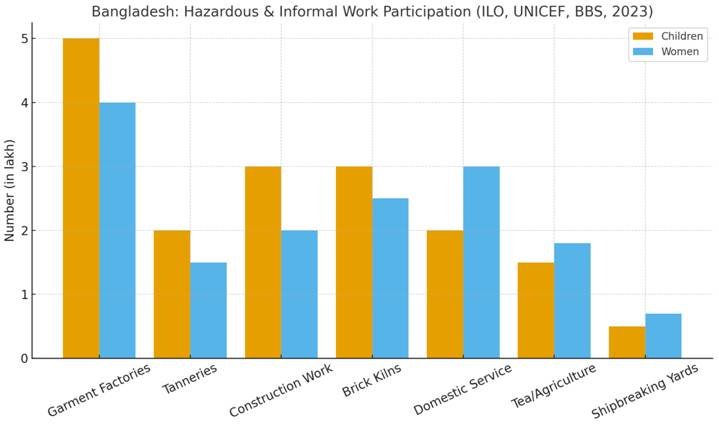
In Bangladesh, children are still engaged in hazardous and illegal forms of work at a significantly higher rate than in many other countries. According to a joint report by the International Labour Organization (ILO) and UNICEF (2023), more than 3.5 million children in Bangladesh are involved in child labor, of which over 1.2 million are engaged in hazardous occupations — such as garment factories, tanneries, construction work, tea plantations, brick kilns, and domestic service.
This rate remains one of the highest in South Asia. Most child laborers come from urban slums and poor rural families. Poverty, lack of access to education, and low social awareness continue to deepen and sustain this issue.
Woman:
In Bangladesh, a significant number of women are still engaged in hazardous, unsafe, and informal sectors of work that are not suitable for their physical health, safety, or legal protection. According to reports from the Bangladesh Bureau of Statistics (BBS), ILO, and UN Women (2023), approximately 1.8 to 2 million women are employed in hazardous or informal occupations.
These include work in tanneries, construction sites, brick kilns, shipbreaking yards, domestic service, and certain garment factory units that lack proper safety standards. Many women in rural areas are also involved in agricultural pesticide handling and manual labor under unsafe condition
Fowling diagram shows the combined diagram showing both children and women in Bangladesh engaged in hazardous or informal work (based on ILO, UNICEF, and BBS 2023 data).
The slogans that will be raised by women or women: –
Women’s contribution is not only in the family or at home – Economically, formal and informal, there should be equal opportunities for women and men everywhere.
– There is a law, an administration, a judicial system to protect women, but in reality there is no implementation, no implementation. “Women have rights – not justice alone.
-If there is development, why are women oppressed?
-Women need not just ‘jobs’ – they need freedom, dignity, decision-making power, a path to progress. “Women’s empowerment – development of the country”.
– “If you want development, change your mindset”
Concerns about children and their causes:
- The main drivers of child labor are: poverty, family financial crisis, early dropout from education, and access to work.
- The limited opportunities for children to learn and develop normally — they are working, falling behind in school, not getting opportunities for sports — are very worrying from the perspective of human rights and overall human development.
- Although progress has been made in some sectors in Bangladesh, the situation is not progressing fast enough and child labor still exists in many cases.
Breaking the cycle and solve the problems:
Closing the Gender Pay Gap
Women in Bangladesh often earn less than men for the same work.
Here’s how to change that:
- Enforce “Equal Pay for Equal Work” laws across all sectors.
- Provide vocational and digital skill training to women for better-paid jobs.
- Ensure wage transparency in both public and private organizations.
- Create safe workplaces with maternity leave, childcare, and health facilities.
- Support women entrepreneurs through microcredit, training, and market access.
Ending Rape and Sexual Violence
Gender-based violence remains a grave concern. Justice and prevention must go hand in hand.
- Strengthen fast-track tribunals for timely trials and punishment.
- Establish victim-friendly police units with trained female officers.
- Include gender respect and consent education in school curricula.
- Protect survivors’ identities and ensure responsible media reporting.
- Build community watch groups to ensure local safety and accountability.
Preventing Domestic Violence
Home should never be a place of fear.
To protect women and children from abuse:
- Strictly enforce the Domestic Violence Prevention Act.
- Expand shelters and the national 109 helpline for immediate support.
- Provide family counseling and mediation centers at the local levels.
- Empower women economically to reduce dependency on abusers.
- Promote public awareness through religious leaders, teachers, and the media.
Eradicating Child Labor
Millions of Bangladeshi children still work instead of learning.
To secure their future:
- Ban all labor for children under 14 and strengthen inspection systems.
- Support poor families financially with stipends, food, and skill training.
- Guarantee free and quality education with school meals and incentives.
- Expand vocational education for older adolescents.
- Run awareness campaigns making child labor socially unacceptable.
United for Change
Real transformation demands collaboration and courage.
- Empower the National Women and Child Commission with greater authority.
- Build stronger partnerships between the government, NGOs, and global agencies.
- Use digital monitoring systems to track progress transparently.
- Expand legal aid and rehabilitation centers nationwide.
- Continue education and social campaigns to shift cultural mindsets.
Join the Movement
Every step toward justice begins with awareness — and every voice matters.
Let us stand together to create a Bangladesh where no woman is silenced and no child is exploited.
💖 Together, we can build a nation of dignity, safety, and equal opportunity for all. Land of disparity is what it hopes for
Written by : Proggya roy
15th September, 2025,
29 Bhadro, 1432